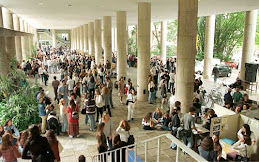
I have been home about 5 days and here are a few things that initially hit me hard when getting off the plane:
-Everyone is so WHITE
-So many overweight people
-I can understand every conversation! weirdddd
-Buildings and roads are so clean
-When I greet someone and try to hug them/kiss them they aren't quite as accustomed to it :) Opps!
-So much green space
-Fast food everywhere
-So much wasted energy in my house
-I have too many things
So far, it has been a pretty easy adjustment. I think this is partly because I have already spent so much time reflecting and thinking about my experiences that I understand where I am coming from and where I am going. I know there will be some rough patches adjusting back into this culture after being away for so long, but I hope to remember all my initial impressions to better understand the culture I live in.
July 21, 2010


There is a season for everything
Like they say, there is a season for everything and it was time for my time in Brazil to end and to rejoin my family and friends in Illinois. I would make this a long reflective blog, however, I feel like I have done enough reflecting and I'm just pumped to be home. As you can tell, I had the time of my life, but I have also come to value a lot of things from home that I used to take for granted. Grass, corn, clean streets, driving, and country music are just some examples :) However, though I am leaving Brazil, I am taking with me some things that I love about the culture and hope to integrate into my own life in the US:
1. Keep it simple. Simpler lives are happier lives
2. Don’t forget to help others
3. Live without stress… or at least try
4. Don’t pre-judge, sometimes after you get to know someone they are much different than you first thought
5. Bread and cheese for breakfast… mmmm!
6. Walking whenever possible
7. Meet new people whenever possible
8. Energy conservation! Unplug everything that is not being used, don’t waste anything
9. Keep practicing Portuguese
10. Keep in contact with Brazilian friends
11. Last minute trips with no planning usually end up being more fun!
12. Hug and kiss more =)
13. Just DANCE! Doesn't matter if you are good or not.. just do it!
14. Remember the value of family
1. Keep it simple. Simpler lives are happier lives
2. Don’t forget to help others
3. Live without stress… or at least try
4. Don’t pre-judge, sometimes after you get to know someone they are much different than you first thought
5. Bread and cheese for breakfast… mmmm!
6. Walking whenever possible
7. Meet new people whenever possible
8. Energy conservation! Unplug everything that is not being used, don’t waste anything
9. Keep practicing Portuguese
10. Keep in contact with Brazilian friends
11. Last minute trips with no planning usually end up being more fun!
12. Hug and kiss more =)
13. Just DANCE! Doesn't matter if you are good or not.. just do it!
14. Remember the value of family
My tattoo
So my third to last day in Rio, I may or may not have gotten a tattoo ☺ Don’t worry, it wasn’t as rash as it sounds. I have been thinking about it for over a year and I felt like Rio was the place to do it.

It is the design of the Christian fish. Back when Christianity was outlawed in the Roman Empire, Christians lived under great fear. When meeting someone for the first time, to discover whether the other was a Christian, they would casually draw an arc in the sand in the shape of the upper swoop of the fish. If the other recognized the symbol, they would complete the lower swoop of the fish to indicate they were also Christian and the two would talk about their faith without fear. If the other was not a Christian, the swoop in the sand caused no suspicion and they easily erased it with their toe.
Under the fish, it says “Prov 3:5” in beautiful old script. The verse is the following:
“Trust in the Lord with all your heart, and lean not on your own understanding; in all your ways, acknowledge him, and he will direct your path.”
This passage has many meanings to me. First of all, when I was a child, my parents used to sing this proverb to me whenever I was upset. I chose to put it on my foot as a calming reminder that God is guiding my steps. All you need to do is trust Him. When I was confirmed, I chose this passage as my confirmation verse. Not only that, but Jesus taught us to be “fishers of men” and this serves as a reminder of that. Now, not only does it remind me of all of this, it also reminds me of my time in Rio and of the friendships I made there.
And let me tell you, the mere experience of getting the tattoo is a memory to go down in the books. I went to “Helio’s Tattoos” in Ipanema, which apparently is pretty famous. The guy that runs the place, Helio, is one of the most eccentric and artistic people I have ever come across. First, he called us into his small workroom to talk while he was painting a huge tattoo on a naked woman’s back. No one seemed to mind and he just kept working while we chatted. Then, while we were waiting to he brought my friend and I into a small room he came out to watch youtube videos of bossa nova to “unwind.” He also showed us his photography and took pictures of our eyes to add to his collection, which he wants to make into an art piece someday.
Finally, after about 2 ½ hours of waiting, brought us into his workroom and put in a music video of tango and turned off the lights as he chatted to us about his life as a former alcoholic and about his beautiful family. The tattoo itself hurt a bit, but not as much as I thought it would. It only took 20 minutes or so and he did an amazing job. Afterwards, he showed us pictures of his family and then began explaining to us how Spiritualism encompasses all religions. He talked about that for the next 10 minutes and even gave us a book on it. Did he realize he just put a Christian symbol on my foot?
Needless to say, I couldn’t have asked for a more memorable experience.

It is the design of the Christian fish. Back when Christianity was outlawed in the Roman Empire, Christians lived under great fear. When meeting someone for the first time, to discover whether the other was a Christian, they would casually draw an arc in the sand in the shape of the upper swoop of the fish. If the other recognized the symbol, they would complete the lower swoop of the fish to indicate they were also Christian and the two would talk about their faith without fear. If the other was not a Christian, the swoop in the sand caused no suspicion and they easily erased it with their toe.
Under the fish, it says “Prov 3:5” in beautiful old script. The verse is the following:
“Trust in the Lord with all your heart, and lean not on your own understanding; in all your ways, acknowledge him, and he will direct your path.”
This passage has many meanings to me. First of all, when I was a child, my parents used to sing this proverb to me whenever I was upset. I chose to put it on my foot as a calming reminder that God is guiding my steps. All you need to do is trust Him. When I was confirmed, I chose this passage as my confirmation verse. Not only that, but Jesus taught us to be “fishers of men” and this serves as a reminder of that. Now, not only does it remind me of all of this, it also reminds me of my time in Rio and of the friendships I made there.
And let me tell you, the mere experience of getting the tattoo is a memory to go down in the books. I went to “Helio’s Tattoos” in Ipanema, which apparently is pretty famous. The guy that runs the place, Helio, is one of the most eccentric and artistic people I have ever come across. First, he called us into his small workroom to talk while he was painting a huge tattoo on a naked woman’s back. No one seemed to mind and he just kept working while we chatted. Then, while we were waiting to he brought my friend and I into a small room he came out to watch youtube videos of bossa nova to “unwind.” He also showed us his photography and took pictures of our eyes to add to his collection, which he wants to make into an art piece someday.
Finally, after about 2 ½ hours of waiting, brought us into his workroom and put in a music video of tango and turned off the lights as he chatted to us about his life as a former alcoholic and about his beautiful family. The tattoo itself hurt a bit, but not as much as I thought it would. It only took 20 minutes or so and he did an amazing job. Afterwards, he showed us pictures of his family and then began explaining to us how Spiritualism encompasses all religions. He talked about that for the next 10 minutes and even gave us a book on it. Did he realize he just put a Christian symbol on my foot?
Needless to say, I couldn’t have asked for a more memorable experience.
World Cup Madness
The past month and a half, the city has been alive with World Cup madness. Fifa set up a huge TV on Copacabana beach where I (and thousands of others) watched the majority of the games. It was interesting hearing the Brazilian perspective of the Brazilian team compared with the international commentary. For example, many Brazilians told me they didn’t think the team was strong enough to win because the coach hadn’t selected some of the best players to play for the national team. Coach Dunga was a controversial choice because he likes his team to play very regimented and technical, much different than the energetic flair of Pelé that Brazilians pride themselves on. Also, the strong rivalry with Argentina was never more prominent than when Argentina lost to Spain? After Brazil had already been knocked out. By celebrations that took place after the game, you would have thought Brazil had won! However, quickly after Brazil lost, the city returned to normal and seemed to completely forget that the World Cup had even happened. The hype is already beginning for the 2014 World Cup in Rio!
June 26, 2010
More reflections
A job application I recently completed asked me some thought provoking questions reflecting on my time abroad. This is one of the questions (and my answer) that I found really personally rewarding to answer.
How did your experiences affect you personally, professionally, and academically?
It is hard to put into words how my experiences in Brazil have affected me, but here is my best effort. Academically, I took classes in Portuguese, Community Development, Brazilian Foreign Policy and Social Political and Economic History of Brazil. As a Psychology and Political Science major (with minors in Latin American Studies and Portuguese) these courses were very interesting to me because they aligned directly with my passions. Specifically, I really enjoyed my course on Brazilian Foreign Policy because I learned how to think about world events from a completely different perspective. This class included students from many countries, all of whom had different perspectives on current world events and policies. I also found it very interesting to learn the Brazilian perspective of US actions such as the war in Iraq and interventions within South America. I was constantly comparing articles I read in the New York Times to articles in Brazilian newspapers, which told the story of the same event in different ways. Overall, I learned that in the academic world, you must always consider your cultural perspective when analyzing anything.
Professionally, I learned that I would enjoy living and working abroad. However, I also think it is very important to learn the language of the place you are living. I can’t even count how many times Brazilian’s attitudes towards me completely changed once they realized that I was learning Portuguese. So many doors were opened to me when people saw that I respected their culture and was making the effort to learn their language. I also learned that I do not think I would like teaching English long-term to children. I certainly enjoyed my experience but was surprised how difficult and draining it is to teach children. Perhaps I would like to teach adults after more training. Finally, I took the opportunity to visit the American Consulate in Rio to speak with a State Department official about employment opportunities. I learned about many opportunities to work abroad and plan on looking into jobs with the State Department and other US agencies that work internationally.
Personally, I grew more than I thought possible. When my mom visited me for the week, she commented on how much more confident I seemed. In general, I think that I learned the importance of a simpler and less stressful life. This is something that really struck me when I first arrived because people do not have any “extra” things that they don’t use in their homes or in their lives. They value everything they have, which is something I know that I could certainly work on. Also, for my Community Development class, I visited several favelas around Rio with classmates who live there. They showed us the realities that these people face, both good and bad, and I learned the importance of using whatever you have to help others. Most of my classmates were on scholarships to study at my university and some commuted more than two hours each way to get to class. They did all of this happily because they felt blessed to have the opportunity to go to college. They also planned to return to use what they learned to better their communities. I hope to keep these lessons with me to wherever I go from here.
How did your experiences affect you personally, professionally, and academically?
It is hard to put into words how my experiences in Brazil have affected me, but here is my best effort. Academically, I took classes in Portuguese, Community Development, Brazilian Foreign Policy and Social Political and Economic History of Brazil. As a Psychology and Political Science major (with minors in Latin American Studies and Portuguese) these courses were very interesting to me because they aligned directly with my passions. Specifically, I really enjoyed my course on Brazilian Foreign Policy because I learned how to think about world events from a completely different perspective. This class included students from many countries, all of whom had different perspectives on current world events and policies. I also found it very interesting to learn the Brazilian perspective of US actions such as the war in Iraq and interventions within South America. I was constantly comparing articles I read in the New York Times to articles in Brazilian newspapers, which told the story of the same event in different ways. Overall, I learned that in the academic world, you must always consider your cultural perspective when analyzing anything.
Professionally, I learned that I would enjoy living and working abroad. However, I also think it is very important to learn the language of the place you are living. I can’t even count how many times Brazilian’s attitudes towards me completely changed once they realized that I was learning Portuguese. So many doors were opened to me when people saw that I respected their culture and was making the effort to learn their language. I also learned that I do not think I would like teaching English long-term to children. I certainly enjoyed my experience but was surprised how difficult and draining it is to teach children. Perhaps I would like to teach adults after more training. Finally, I took the opportunity to visit the American Consulate in Rio to speak with a State Department official about employment opportunities. I learned about many opportunities to work abroad and plan on looking into jobs with the State Department and other US agencies that work internationally.
Personally, I grew more than I thought possible. When my mom visited me for the week, she commented on how much more confident I seemed. In general, I think that I learned the importance of a simpler and less stressful life. This is something that really struck me when I first arrived because people do not have any “extra” things that they don’t use in their homes or in their lives. They value everything they have, which is something I know that I could certainly work on. Also, for my Community Development class, I visited several favelas around Rio with classmates who live there. They showed us the realities that these people face, both good and bad, and I learned the importance of using whatever you have to help others. Most of my classmates were on scholarships to study at my university and some commuted more than two hours each way to get to class. They did all of this happily because they felt blessed to have the opportunity to go to college. They also planned to return to use what they learned to better their communities. I hope to keep these lessons with me to wherever I go from here.
The American Stereotype
US stereotypes are not only caused by the President and leadership, but by the impressions that others get of American’s living in their countries. I have experienced two types of Americans living abroad. The first type, are those that come to the country to really learn the culture, participate in every aspect of daily life, absorb themselves in the opportunities, and really respect the people. The other type, are those that give Americans a bad name. You know the ones. Loud, obnoxious, and disrespectful (with or without intentionally doing it). In Brazil right now, it seems to me that more and more type 2 kinds are coming to scout out business opportunities. With Brazil’s economy growing at 5% while the rest of the world is still climbing out of the financial crisis, investors are seeing the personal benefits that expanding into the Brazilian market brings them. Although some of these people really do mean well and give back to the communities they live in, others are, in my opinion, just continuing the ancient practice of imperialism with a new modern twist. They give little thought to the damage that they are doing to the people there.
For example, I recently visited Rocinha (the largest favela in South America) with my Community Development class, led by several people in our class who live there. Our first stop was the top of the morro where we wandered into a bar/restaurant/pool table lounge/car repair shop/owner’s home to talk to the man who owned it about this particular area of the community. He told us that after the recent heavy rainstorm and flooding that caused mudslides within other favelas, the government was using the opportunity to “relocate” over 13,000 families from this part of Rocinha to the outskirts of the city. The government claims it is for the people’s safety, but this man told us of a different reality. He said that the people that built these “houses” piled one on top of the other, are the same people who also often work for the Brazilian government as construction workers and have built most of Rio. They know what they are doing and the structures are sound. He said that the government is hoping to relocate these people so that they can sell the property (with a perfect location near the tourist areas and gorgeous view of the whole city and beaches) to make room for a high-rise hotel. In fact, the government closed the school for “safety reasons” that served to educate the local children. Now, the government argues that the people there are living in a dangerous area without access to education and that they should move to a “better” environment an hour and a half away from where they currently live. The community is currently organizing efforts to rebuild the school out of their own pockets to make it harder for the government to kick them out.
Many foreign businesses are beginning to see the areas that favelas now inhabit (often with the best views of the city) as moneymakers and are trying to take over the property. These enterprising individuals often don’t realize how much damage they are really doing, and only see the personal gain.
I guess people in developing countries are used to being used. One brazilian asked me “so you are just learning Portuguese so that you can get a good job back in the US, right? Will you ever come back?” Of course I will be back. You probably won’t be able to get rid of me now ☺ But this is not the sentiment that they expect.
My host mom is always so surprised and impressed when I leave “Zona Sul” where I live and visit friends in less affluent parts of the city. She told me about another girl who lived with her for some time and never left this area. She described the girl as “very very American.” “What do you mean by that?” I asked, and then she realized her mistake. “I’m sorry but many American’s I have met are very closed-minded and only see what they want to see.”
The American stereotype abroad sucks. For this to change, it not only takes a change in foreign policy at the upper-most levels of government, but also the change in attitude of those millions of Americans living abroad. Can we change it? Yes we can ☺
For example, I recently visited Rocinha (the largest favela in South America) with my Community Development class, led by several people in our class who live there. Our first stop was the top of the morro where we wandered into a bar/restaurant/pool table lounge/car repair shop/owner’s home to talk to the man who owned it about this particular area of the community. He told us that after the recent heavy rainstorm and flooding that caused mudslides within other favelas, the government was using the opportunity to “relocate” over 13,000 families from this part of Rocinha to the outskirts of the city. The government claims it is for the people’s safety, but this man told us of a different reality. He said that the people that built these “houses” piled one on top of the other, are the same people who also often work for the Brazilian government as construction workers and have built most of Rio. They know what they are doing and the structures are sound. He said that the government is hoping to relocate these people so that they can sell the property (with a perfect location near the tourist areas and gorgeous view of the whole city and beaches) to make room for a high-rise hotel. In fact, the government closed the school for “safety reasons” that served to educate the local children. Now, the government argues that the people there are living in a dangerous area without access to education and that they should move to a “better” environment an hour and a half away from where they currently live. The community is currently organizing efforts to rebuild the school out of their own pockets to make it harder for the government to kick them out.
Many foreign businesses are beginning to see the areas that favelas now inhabit (often with the best views of the city) as moneymakers and are trying to take over the property. These enterprising individuals often don’t realize how much damage they are really doing, and only see the personal gain.
I guess people in developing countries are used to being used. One brazilian asked me “so you are just learning Portuguese so that you can get a good job back in the US, right? Will you ever come back?” Of course I will be back. You probably won’t be able to get rid of me now ☺ But this is not the sentiment that they expect.
My host mom is always so surprised and impressed when I leave “Zona Sul” where I live and visit friends in less affluent parts of the city. She told me about another girl who lived with her for some time and never left this area. She described the girl as “very very American.” “What do you mean by that?” I asked, and then she realized her mistake. “I’m sorry but many American’s I have met are very closed-minded and only see what they want to see.”
The American stereotype abroad sucks. For this to change, it not only takes a change in foreign policy at the upper-most levels of government, but also the change in attitude of those millions of Americans living abroad. Can we change it? Yes we can ☺
June 10, 2010
And they told me Rio was dangerous... what about Champaign?
In the last semester, I have received many crime alert e-mails from University of Illinois about robberies and assaults that have occurred on campus at various times during the day and night. And they told me Rio was dangerous…
On that note, I wanted to talk a little about crime here. Rio has a reputation for being a city full of street children and drug traffickers who are always on the prowl. Although the city certainly has its fair share of crime, I am surprised how different it is from my preconceptions. Before coming, I was told not to bring anything valuable because it WILL get stolen. While it is best to not have much on you while walking around the city, it really depends on your location.
Residents of Rio are very aware of the city’s rep as a dangerous place and are working hard to change that perception. From my experience, as long as you stay in places that aren’t super touristy and are smart and aware of your surroundings, you probably won’t have problems. However, things happen regardless of how safe you are being. Two of my friends were walking around Lagoa (a big lake in the center of the city) at 3pm one afternoon with a guy friend and 3 or 4 teenagers robbed them at knifepoint. There were plenty of people around and they weren’t wearing flashy clothes or anything. Things happen. Most of the time, all they want is money. They aren’t trying to hurt anyone. Just give it up and you will be fine.
I also get this vibe that many people (especially wealthy Cariocas) live with a constant feeling of fear. When I told my host mom about some of the awesome things I’ve done and seen that are certainly “off the beaten path” (aka: in poorer areas of the cities), she was dumbfounded that I even considered going there. I have experienced this reaction by many other upper-class people as well. However, when talking with middle or lower-class people, they respond much differently. To them, it is their community, their home, and they feel safe there because they understand the environment. When I visit these places, I am always with people who live there or know the area and I sometimes feel MORE safe in these areas than in the richer parts of the city where many poor people are hanging out in hopes of getting some quick cash.
Overall, yes, Rio has a lot of crime, but not a significant amount more than other cities in Brazil, or in the world. In my opinion, we need to cut Rio a break. This reputation for crime is quite exaggerated.
On that note, I wanted to talk a little about crime here. Rio has a reputation for being a city full of street children and drug traffickers who are always on the prowl. Although the city certainly has its fair share of crime, I am surprised how different it is from my preconceptions. Before coming, I was told not to bring anything valuable because it WILL get stolen. While it is best to not have much on you while walking around the city, it really depends on your location.
Residents of Rio are very aware of the city’s rep as a dangerous place and are working hard to change that perception. From my experience, as long as you stay in places that aren’t super touristy and are smart and aware of your surroundings, you probably won’t have problems. However, things happen regardless of how safe you are being. Two of my friends were walking around Lagoa (a big lake in the center of the city) at 3pm one afternoon with a guy friend and 3 or 4 teenagers robbed them at knifepoint. There were plenty of people around and they weren’t wearing flashy clothes or anything. Things happen. Most of the time, all they want is money. They aren’t trying to hurt anyone. Just give it up and you will be fine.
I also get this vibe that many people (especially wealthy Cariocas) live with a constant feeling of fear. When I told my host mom about some of the awesome things I’ve done and seen that are certainly “off the beaten path” (aka: in poorer areas of the cities), she was dumbfounded that I even considered going there. I have experienced this reaction by many other upper-class people as well. However, when talking with middle or lower-class people, they respond much differently. To them, it is their community, their home, and they feel safe there because they understand the environment. When I visit these places, I am always with people who live there or know the area and I sometimes feel MORE safe in these areas than in the richer parts of the city where many poor people are hanging out in hopes of getting some quick cash.
Overall, yes, Rio has a lot of crime, but not a significant amount more than other cities in Brazil, or in the world. In my opinion, we need to cut Rio a break. This reputation for crime is quite exaggerated.
Subscribe to:
Posts (Atom)